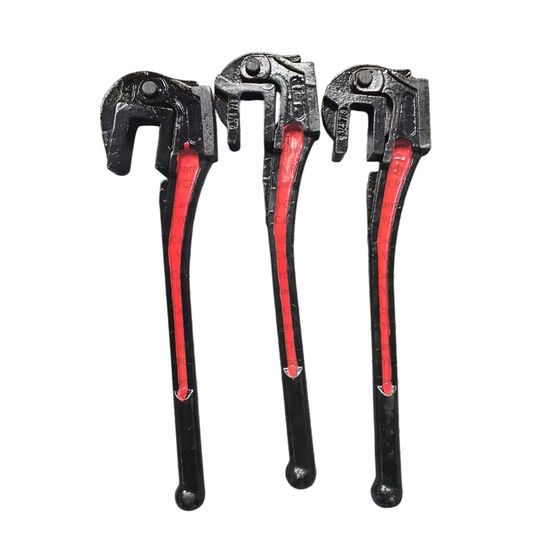
API Sucker Rod Wrench for Oilfield

API Wellhead Handling Tools Sucker Rod Wrench for Oilfield

API Sucker Rod Wrench Wellhead Handling Tools for Oilfield Drilling

I have found results from4000+products and1000+suppliers aboutSucker rod wrench


When sourcing sucker rod wrenches, prioritize high-strength alloy steel (such as 4130 or 4140) that has undergone heat treatment to ensure a hardness level of HRC 40-48. The wrench must feature a precision-opening design that matches API sucker rod sizes (e.g., 5/8", 3/4", 7/8", 1", and 1-1/8"). Look for a balanced handle design to reduce operator fatigue and ensure the tool meets API Spec 7B or equivalent international standards for dimensional accuracy and load-bearing capacity.
Durability is verified through tensile strength tests and torque limit certifications. Ensure the supplier provides Magnetic Particle Inspection (MPI) reports to guarantee the absence of surface cracks or casting defects. For safety, the wrench should have a non-slip grip surface and a smooth finish to prevent hand injuries. A high-quality wrench should withstand 1.5 times the rated torque without permanent deformation.
For the North American market, compliance with API (American Petroleum Institute) standards is essential. For the European market, ensure the products carry the CE mark and comply with the Machinery Directive 2006/42/EC. Additionally, manufacturers should hold ISO 9001:2015 certification to demonstrate a consistent quality management system. Always request Material Test Reports (MTRs) to verify the chemical composition of the steel.
Yes, for manual operations, standard heavy-duty hand wrenches are sufficient. However, for high-efficiency workovers, you may need to source pneumatic or hydraulic power tongs that incorporate wrench-like jaw designs. For corrosive environments (H2S or CO2 wells), specify nickel-plated or specialized coating finishes to prevent hydrogen embrittlement and surface oxidation.
The primary risks include material substitution (using inferior steel) and dimensional inaccuracies. Mitigate these by requesting pre-shipment inspections (PSI) conducted by third parties like SGS or Intertek. Use secure payment methods such as Letters of Credit (L/C) or trade assurance services provided by reputable platforms like Made-in-China.com to ensure funds are only released upon proof of quality compliance.
Focus on Total Cost of Ownership (TCO) rather than just the unit price. Negotiate for volume-based discounts (typically 10-20% for orders over 500 units) and insist on a 12-month quality warranty. Ask the supplier if they can provide custom branding (OEM) and specialized packaging to prevent damage during long-haul sea freight.
Sucker rod wrenches are heavy and dense, making Sea Freight (FCL or LCL) the most economical choice. Ensure the supplier uses seaworthy packaging, such as fumigated wooden crates with VCI (Volatile Corrosion Inhibitor) bags to prevent rusting during transit. For urgent needs to the US or Middle East, Air Freight is possible but will significantly increase the landed cost per unit.
Stay informed about anti-dumping duties and tariffs (such as Section 301 in the US) that may apply to Chinese steel products. Verify the HS Code (typically 820411) with your customs broker to calculate accurate duties. Choosing a supplier on Made-in-China.com who is an Audited Supplier can help ensure they have the correct export licenses and documentation to avoid customs delays.